

Agents of Fascism: The Rejected Script the Ultra-Left Is Still Following
Tracing the century-old ideological script that transforms a pogrom into “resistance” — and why the Comintern eventually tore it up

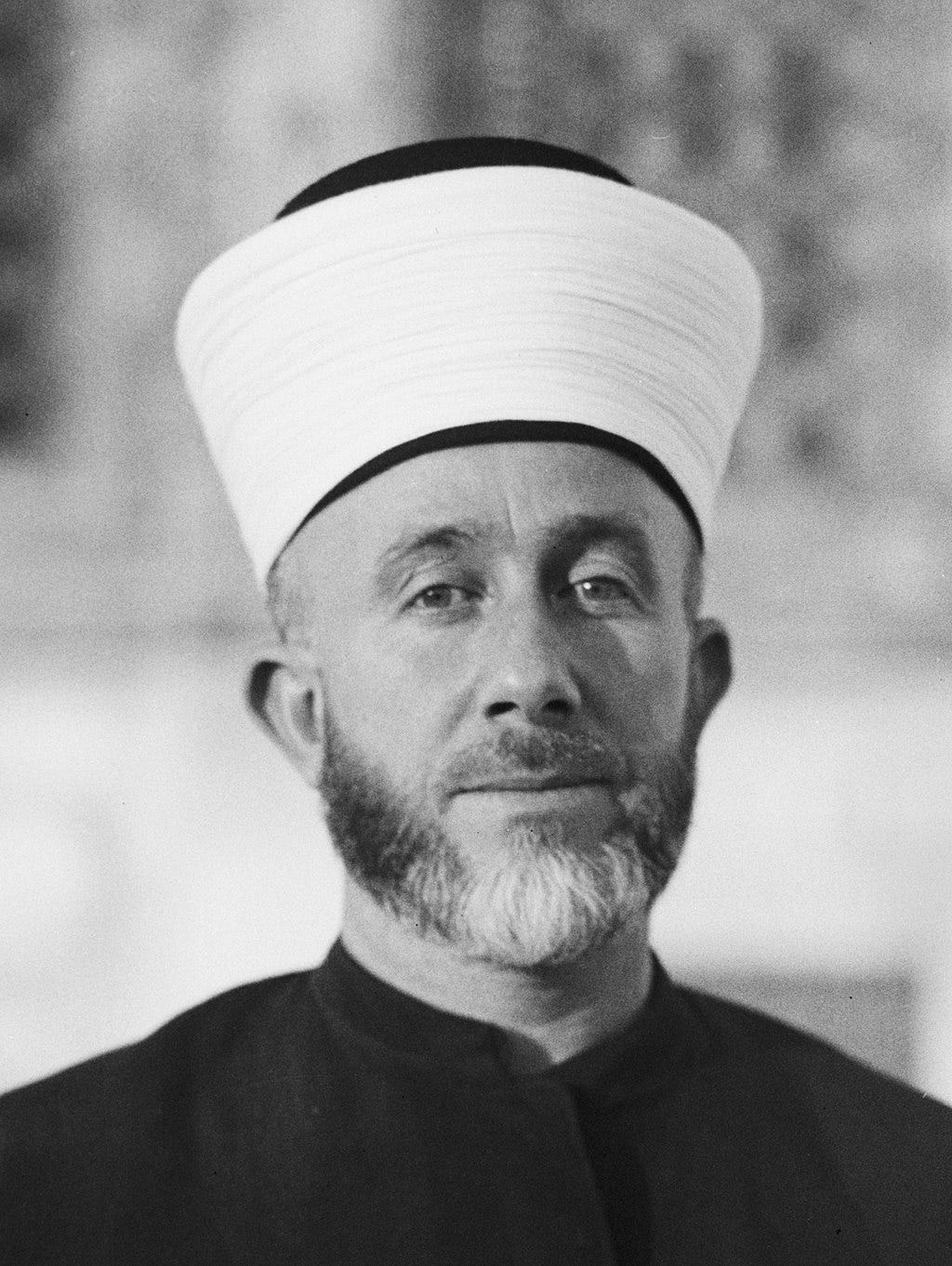
In my previous two articles in this series for Leaden Skies, I examined the legacy of the Grand Mufti Haj Amin al-Husseini’s post-war work with Nazis and his networks in Egypt and elsewhere. In this third instalment, I look at the ideological framework that set the precedent to allow his movement to be rebranded as “resistance.” By tracing the Comintern’s “Third Period” script of 1929, we see how the organisation first provided an alibi for the Mufti’s violence — and why their 1939 reversal, which branded him an “agent of German fascism,” is a warning many on the left ignore.
When the massacre and hostage taking of Israelis (and others) was carried out by Hamas and their Islamist allies on October 7 2023, the immediate response from most socialists and trade unionists was one of horror at the antisemitic crimes committed that day.
Then, as the Hamas and clerical-fascist Iranian propaganda machines got into gear, within days the narrative shifted, before Israel had responded in the way it did. Sentimentality about the killing of some 1,200 people paled into insignificance compared to the crimes of the Israeli occupation.
To many, this appeared to be a sudden and inexplicable collapse of left-wing logic — a descent into a worldview that was unthinkable before.
Except it wasn’t new.
We had seen this exact script play out, almost to the letter, nearly 100 years earlier.
The precedent: The Hebron Massacre
In August 1929 a mob of Hebron’s local residents, joined by people from outside the area tooled up with axes, clubs and knives, engaged in a house-to-house systematic slaughter of the city’s Jews. Medical records and survivor testimonies paint a harrowing picture of mutilation, torture, and sexual violence. Elderly rabbis, women, and infants were amongst the 67 Jews who died.
While the tragedy unfolded in Hebron, its spark was nearly 20 miles north at Jerusalem’s Western Wall. A year of escalating disputes over Jewish prayer rights at the holy site had been weaponised by the Grand Mufti, Haj Amin al-Husseini, who spread inflammatory rumours that the Al-Aqsa Mosque was under imminent threat. This fear acted as the catalyst for nationwide unrest.
Not everyone fell for the Mufti’s propaganda. Some 435 Jews survived the onslaught, shielded by 28 local Arab families who defended their neighbours against the mob.
The immediate aftermath
The bloodbath in Hebron was just the worst part of a week of violence across the country that left 133 Jews dead and 116 Arabs killed, the latter mostly by British police fire.
The Hebron massacre remains the definitive fracture in the history of the British Mandate — a moment when the abstract friction of Jerusalem’s politics ignited a local slaughter. In a matter of days an at least 800-year Jewish presence in one of the most significant urban centres in British Mandate Palestine was ended. The authorities moved the entire Jewish community out in the aftermath.
By the time the survivors were evacuated to Jerusalem, the message was clear for Palestine’s Jews. This was a community facing serious violence. The militarisation of the underground Zionist self-defence force the Haganah — that protected the Jewish communities of what was known as the Yishuv (the pre-state Jewish communities in Palestine) — had become an existential necessity. The Mufti had inadvertently initiated the arming of the victorious organisation that became the basis of the Israel Defense Forces (IDF) upon the state’s establishment in May 1948.
There is no doubt that Arab grievances over land and the future were real, but it took a special kind of malice to direct that anger at the hapless innocent Jews of Hebron.
The Communist Line(s): Fascist Zionists
One outcome was to have long-lasting ramifications. Communists in Palestine and abroad reacted with horror to the events, calling them what it was: a pogrom carried out by reactionaries. They had characterised attacks on the Jewish community the previous year in the same way and remained certain this was the correct analysis. The small communist party saw the defence of Jews as its duty, met with leaders of the Haganah in Jerusalem and put its small arms cache at their disposal.
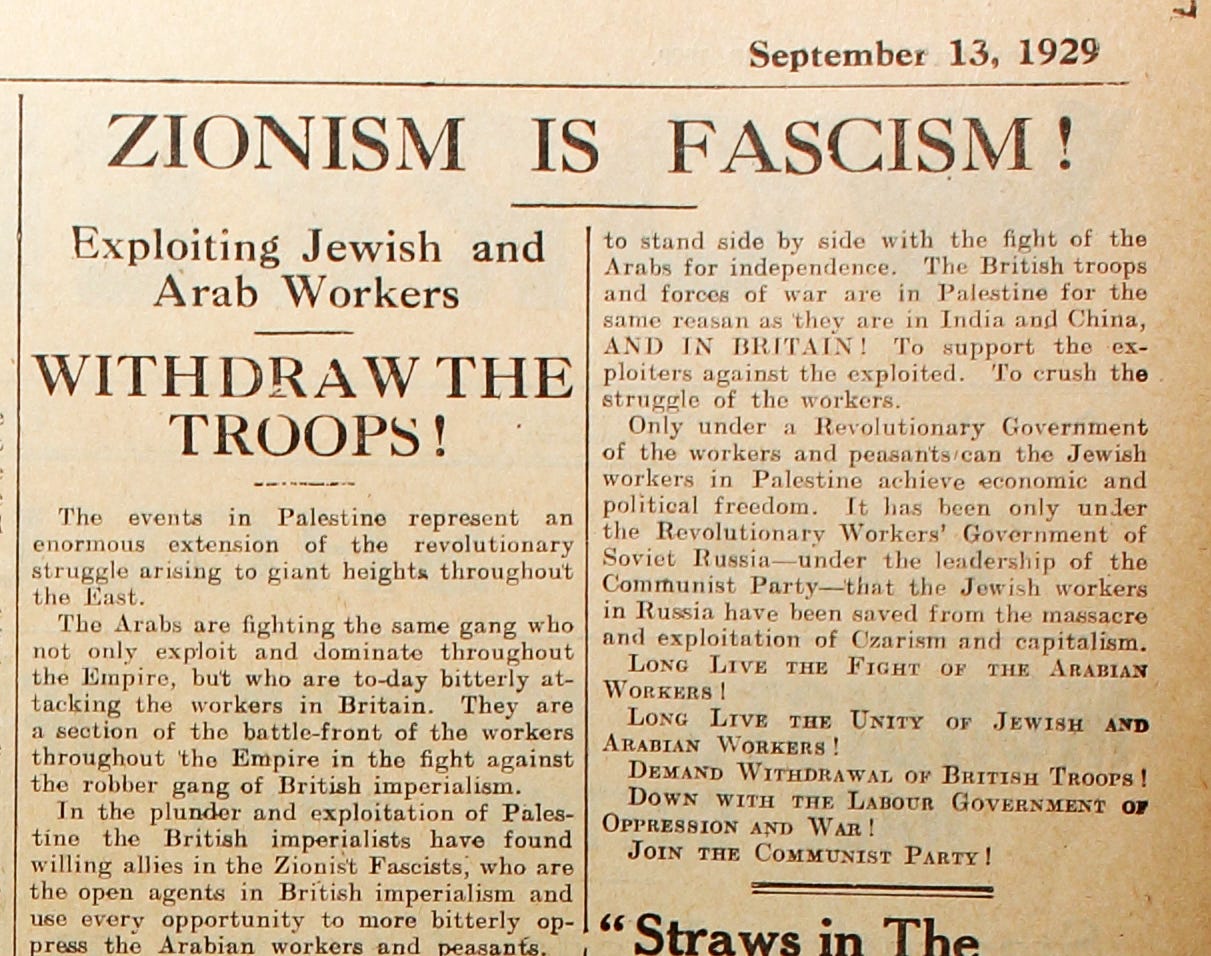
Then the Comintern got the line out. Moscow had entered the “Third Period” — a new sectarian ultra-left phase where it believed capitalism was about to collapse and demanded a “class against class” offensive. In this new world, it wasn’t a pogrom at all but the revolution of the Arab people against the imperialists and exploiters. Now anyone believed to be standing in the way of the revolution, including other socialists, was characterised as a fascist. In Britain that meant the Labour Party; in Palestine, Zionists.
The first official communication by a Comintern controlled organisation came from the League against Imperialism and Colonialism in September. It claimed the fight “was between the Arab inhabitants, and the immigrant Zionist population artificially imported.” Never mind the fact that the Jews of Hebron — where the worst of the violence happened — were not immigrant Zionists, but a religious community that had predated the Mandate by centuries.
Then on 1 October 1929, the official organ of the Communist International made the line even clearer:
“We have before us not simple ‘riots,’ not a pogrom, but a fairly serious movement of the Arab masses against imperialism.”
The volte face
Communist opposition to Zionism at this point was very different to the antisemitic conspiratorial and Nazi-inflected versions that came later and was based on the view that Zionism diverted Jewish workers away from the class struggle and also that Zionism — in the light of the Balfour Declaration — served the interests of British imperialism.
Crucially, prior to the new line, communists opposed the sort of Pan-Islamism that was to whip up the anti-Jewish violence in Hebron and elsewhere. In 1920 Lenin argued in his Draft Theses on National and Colonial Questions:
“for the need to combat Pan-Islamism and similar trends, which strive to combine the liberation movement against European and American imperialism with an attempt to strengthen the positions of the khans, landowners, mullahs, etc.”
That Lenin was talking about the likes of Haj Amin al-Husseini — who became Grand Mufti the following year — is beyond doubt. The al-Husseinis were one of the “Ayan” — the elite class of wealthy Arab land-owning families who had dominated political and religious offices of the region for centuries under the Ottoman Empire.
The Shaw Commission: Legal Realpolitik
Following the 1929 violence, Britain’s Shaw Commission inquiry sought to determine if Zionist “provocations” had sparked the unrest. The Jewish Chronicle of December 6, 1929, reported that Haj Amin al-Husseini, was granted the special privilege reserved for religious leaders of giving evidence in camera at his home. His counsel cited the notorious antisemitic forgery, The Protocols of the Elders of Zion, in his defence.
It was further revealed that Arab press images of “Zionist flags” over Jerusalem’s holy sites were also actually forgeries, repurposed from Jewish New Year cards. Despite this evidence of premeditated incitement, the British performed an exercise in realpolitik. They largely exonerated the Mufti, characterising the slaughter as a “spontaneous” reaction to Zionist ambitions. The resulting Passfield White Paper sought to pacify the perpetrators by strictly restricting Jewish immigration although the final policy was heavily watered down under political pressure.
The Popular Front and the Great Revolt
By 1934, the Third Period line had collapsed under the weight of its own failure. In Germany, the communist branding of Social Democrats as “Social Fascists” had been a disaster; combined with the Social Democrats' own deep-seated distrust and rigid legalism, this lack of unity helped the Nazis to seize power. Consequently, the Comintern pivoted to the “Popular Front”— a strategy of making alliances with any democratic force standing against Hitler and Mussolini. It was this anti-fascist line that helped make communism a popular force in the 1930s and 1940s and famously helped build the International Brigades in Spain and defend the East End of London’s Jewish community.
Meanwhile, in Palestine, the ground was shifting toward a more militant Jihad. Izz al-Din al-Qassam, a Syrian-born cleric, built a clandestine network of fighters in Haifa. Unlike the Mufti’s political manoeuvring, al-Qassam sought an apocalyptic struggle against the British and Zionists. Following his death in a shootout with British police in 1935, his followers sparked the Great Arab Revolt (1936-1939) with the Grand Mufti opportunistically taking the helm.
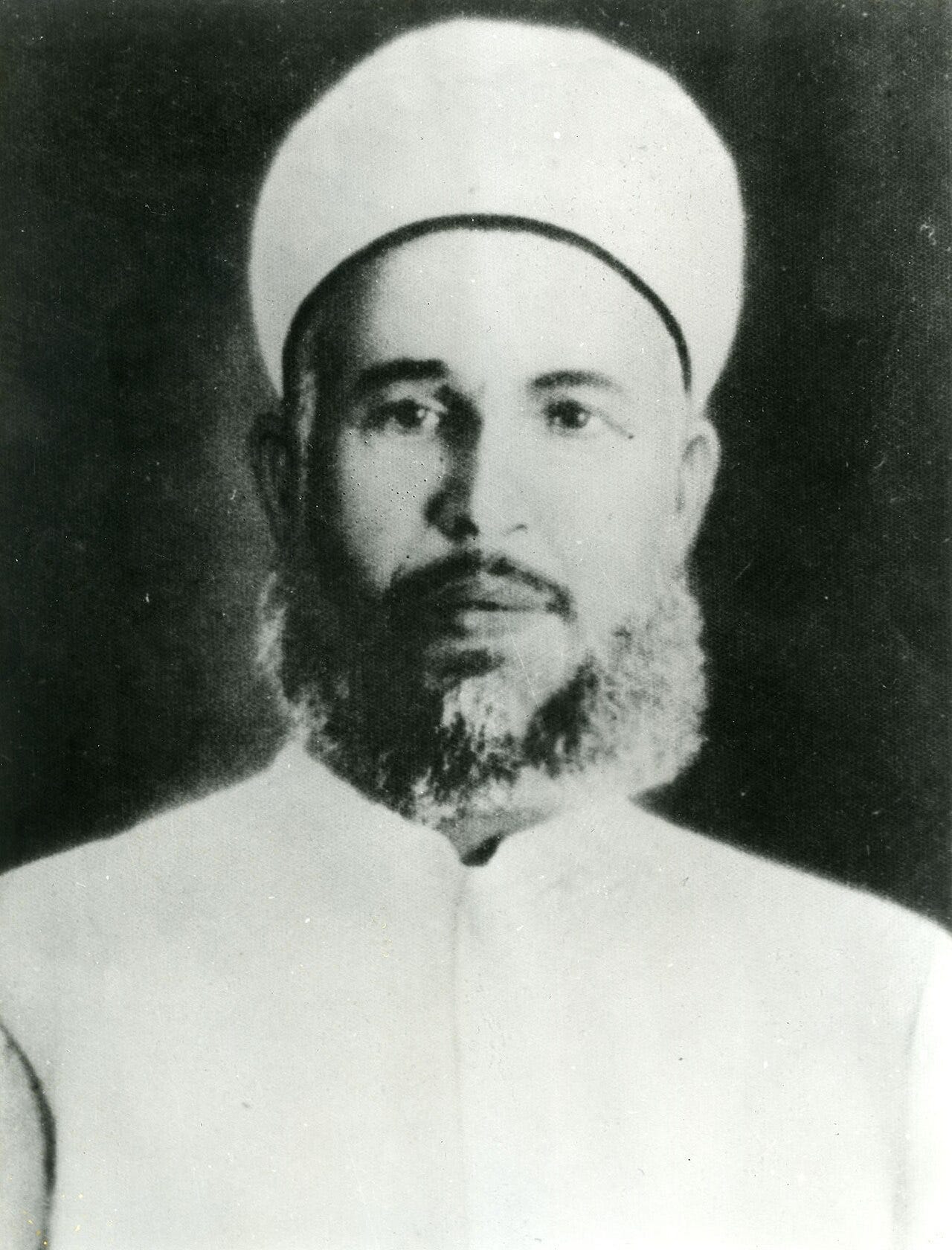
This sustained campaign of strikes and rebellion eventually forced a strategic British retreat: the 1939 White Paper. This time the policy effectively ended the promise of a Jewish National Home by strictly limiting immigration — just as the systematic persecution of European Jewry was reaching a point of no return.
Comintern declares The Mufti an Agent of Fascism
The Arab revolt in the 1930s was a much more serious challenge to British rule than anything that had come before, but now the Comintern viewed it as reactionary. By 1939, it was no longer possible for the Comintern to ignore the reality that the Mufti’s movement was an auxiliary of the Axis. Their reversal was an admission that the “anti-imperialism” they had championed in 1929 had become a vehicle for Nazi expansionism in the Middle East. The January 1939 edition of the Communist International monthly went into chapter and verse how Nazi propagandists were active throughout the Arab world and then declared:
“The responsibility for the present bloodshed in Palestine also falls upon those reactionary elements among the Arabs who constantly betray the interests of their own country. At the head of the insurrection now stands the Mussulman priesthood in Palestine — the Mufti Ali [sic] Hussein — a bought agent of German fascism, whom the fascists claim to be a fighter for the interests of the Arab people.
Ali Hussein and his crew are not only no representatives but they are wreckers and betrayers of the real national movement for the independence of the Arab people, of the just cause of the Arab masses. Mufti Ali Hussein and his clique do not shrink from organizing plots and provocation against the real revolutionary leaders of the Arab people. With such corrupt methods and with such provocation they mask themselves before the Arab people. These traitors are to the forefront in inciting national dissension between Arabs and Jews. They do not confine their agitation to Palestine but carry it on in all Arab countries.”
The Modern Echo of a Centenary Failure
The most enduring legacy of this era is the template the Comintern established in 1929: the idea that targeted anti-Jewish violence can be intellectually rehabilitated if it is framed as anti-imperialism. When the Comintern declared that the Hebron massacre was not a pogrom but a “movement of the Arab masses,” they provided an ideological alibi for slaughter that has been dusted off for the twenty-first century. This same logic echoes in modern anti-Zionist discourse whenever the targeting of Jewish civilians is excused as a necessary component of resistance against a colonial power. By categorising the victims as artificial or imported agents of empire — just as the Comintern did to the ancient Jewish community of Hebron — modern rhetoric denies their status as civilians.
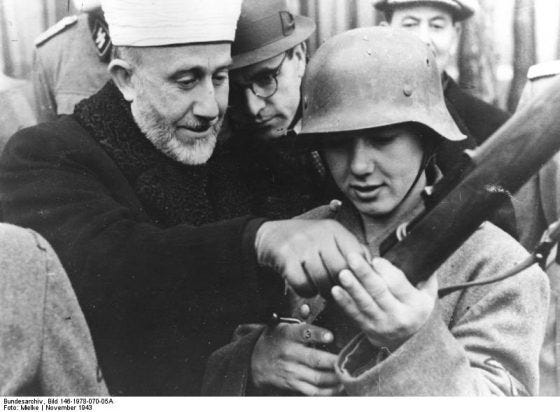
There is a grim irony in the fact that the perpetrators of the October 7th attacks — the Izz al-Din al-Qassam Brigades — carry the name of the very cleric whose movement the Comintern eventually dismissed as reactionary and fascist-aligned in 1939. Ultimately, the Comintern itself recognised its error, branding the Mufti an “agent of Fascism” as his alliance with the Axis powers became undeniable. He spent the war in Berlin as a guest of the Third Reich, meeting with Hitler and broadcasting Nazi propaganda to the Arab world.
Yet, much of today’s ultra-left remains stuck in the Third Period of 1929, retreating into an invented tradition whose provenance they are blissfully unaware of, repeating an analysis that ignores reality. If the left is to be a genuine and serious progressive force, it has to reject the notion that a massacre can be revolutionary and state that in print rather than at very best say nothing.
The left needs to get back to basics: to a time when it understood that a pogrom — the slaughter of Jews — is never a weapon of progress, never justifiable, but an enemy act carried out by the foot soldiers of reaction and the agents of fascism.
The quote from the League against Imperialism and Colonialism is taken from Musa Buderi’s book, The Palestine Communist Party 1919-1948, Haymarket Books.
A Note on Sharing Word-of-mouth is the only way a niche historical project like this grows. If you found this article interesting, please make sure you subscribe. It’s free and I intend to keep it that way. Also consider Restacking it or forwarding this email to someone who values history of interest to anti-fascists.
Every share helps me keep this work going. Thanks for reading.
We have to learn from historical facts . Thanks for this